

Understanding Binary Images and Their Uses
Explore how binary images work, their creation, processing methods, and real-world uses in tech and healthcare industries 🖤⚙️🔍
Edited By
Lucy Hamilton
Extended binary trees are a special type of binary tree widely used in computer science, especially for algorithm design and data structure optimisation. Unlike a regular binary tree where nodes can have zero, one, or two children, every internal node in an extended binary tree must have exactly two children. This constraint creates a more uniform and predictable structure, which simplifies many computational tasks.
To understand the importance of extended binary trees, consider their role in scenarios where completeness is needed—for example, in expression trees, parsing algorithms, or implementing priority queues. These trees help maintain balance and full node occupation, making traversals and manipulations more efficient.
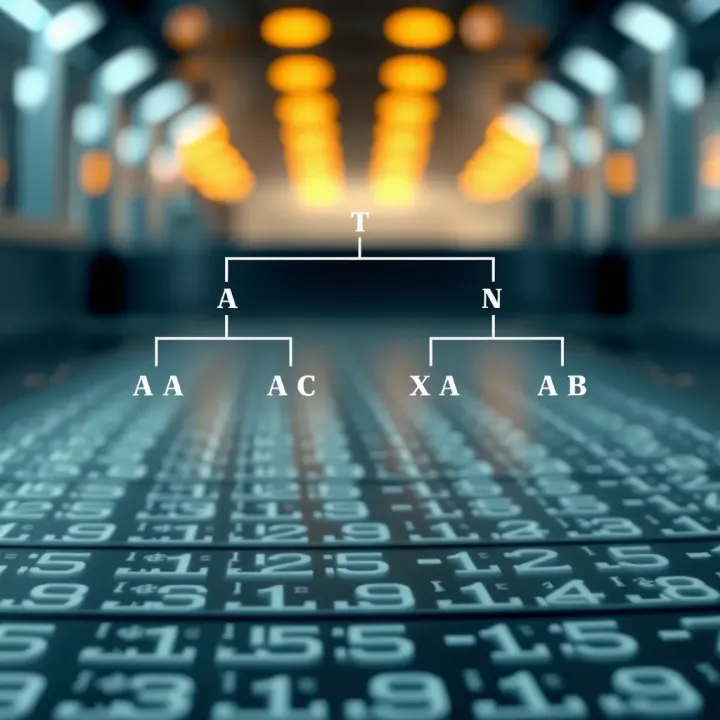
In an extended binary tree, the leaf nodes are represented explicitly as empty (or null) children of internal nodes. This detail provides a straightforward way to handle tree boundaries in recursive algorithms.
Each internal node has two children—either internal nodes or leaf nodes.
Leaf nodes correspond to null pointers, making the tree "full" in the conceptual sense.
The total number of leaves in such a tree is always one more than the number of internal nodes.
The structure of extended binary trees makes them particularly useful for representing hierarchical data where fixed branching is required. For example, parse trees in compiler design need consistent two-child nodes to represent binary operations explicitly. Similarly, decision trees in financial analytics or risk management often rely on such formats to systematically evaluate binary outcomes.
In practical terms, algorithms that navigate extended binary trees tend to be cleaner and simpler because they don’t need to check for missing children explicitly. This reduces edge case handling when performing depth-first or breadth-first traversals, which is vital in time-sensitive applications like real-time trading platforms or cryptocurrency transaction validation.
The next sections will break down how these trees are constructed, explore their core properties, and highlight applications that benefit from their organised structure.
Understanding extended binary trees is fundamental for grasping their role in various computing tasks. These trees ensure every internal node has exactly two children, filling gaps left by traditional binary trees. This strict structure simplifies certain algorithms and clarifies tree behaviour, especially during traversal and storage operations.
Basic definition: An extended binary tree takes a standard binary tree and replaces any missing child nodes with special "external" or "null" nodes, often called leaves. This guarantees that all internal nodes have two children. The practical benefit is consistency; algorithms expecting nodes to always have two children don’t need extra checks for missing branches.
For example, in decision-making algorithms or parsing expression trees, such uniformity improves predictability and efficiency.
Characteristics of nodes: Nodes in an extended binary tree fall into two categories: internal and external. Internal nodes have two children, while external nodes act as placeholders and have no children. These external nodes help clearly mark the end points of branches.
Having this distinction simplifies counting operations—knowing that each null child exists explicitly means one can quickly compute properties like the number of leaves or the tree’s height, which aids in optimising storage and traversal.
Difference between internal and external nodes: Internal nodes carry actual data or decisions in computations. External nodes, on the other hand, don't hold data but serve to pad the tree structure. This clear separation reduces ambiguity, making recursive algorithms easier to implement since base cases often relate to external nodes.
How extended trees fill empty child nodes: Consider a binary tree missing some children. Instead of leaving those child pointers null or empty, extended binary trees replace them with explicit external nodes. Imagine these as small tokens saying, "No more data here," allowing every internal node to meet the “two children” rule.
For instance, a binary search tree with three internal nodes might have five external nodes filling missing branches. These external nodes prevent confusion during traversals like in-order or post-order, especially in complex recursive functions.
Examples of extended binary trees vs standard binary trees: A standard binary tree might look sparse with irregular gaps where children are missing. An extended binary tree, by contrast, fills those gaps with external nodes. Visualising a simple tree with root and one child, the extended version adds external leaves on the missing sides.
This filled structure is especially helpful in advanced algorithms, such as those used in compilers or search optimisation, where predictable tree shapes reduce bugs and aid performance.
In essence, extended binary trees serve as a tidy framework, ensuring every internal node has two children and external nodes explicitly mark the ends. This clarity makes them valuable for computer science applications requiring guaranteed structural regularity.
Key point: Extended binary trees replace missing nodes with external leaves.
Benefit: Simplifies algorithms needing complete node pairs.
Visual difference: Standard trees show gaps; extended trees fill them.
By seeing trees this way, programmers and analysts gain a better handle on tree-based data management and algorithm design.
Extended binary trees stand apart mainly because every internal node has exactly two children, while standard binary trees allow nodes to have zero, one, or two children. This distinction affects both the tree's structure and how it behaves in practice.

In standard binary trees, some child nodes can be missing, meaning these points in the tree are simply null or empty. This creates ambiguity when designing algorithms that assume either a full or nearly complete structure. Extended binary trees fill those gaps by explicitly adding external nodes in place of missing children. These external nodes serve as placeholders, ensuring structural uniformity. For example, a binary search tree converted into its extended form includes nodes representing empty subtrees, making traversal and height calculation straightforward.
The degree — or number of children — of nodes varies between these two trees. Standard binary trees have internal nodes with degrees ranging from zero to two. However, extended binary trees enforce a stricter rule: all internal nodes have exactly two children. This grammar helps simplify certain mathematical proofs and algorithms, such as calculating the number of leaf nodes or balancing the tree.
This consistency also has a practical side. When implementing data structures like heaps or parsing expression trees, each step assumes exactly two children per internal node, which helps avoid edge cases that otherwise require additional checks.
Extended binary trees influence traversal methods by including external nodes in the process. Since every internal node has two children, traversal algorithms—be it in-order, pre-order, or post-order—visit both these children explicitly, instead of skipping null links. This explicitness can streamline recursive or iterative traversal by removing the need for null pointer checks during node visits.
For instance, in expression trees, where leaf nodes represent operands and internal nodes represent operators, having external nodes clearly defined helps in uniform traversal and evaluation steps.
While external nodes ensure a complete structure, they introduce extra elements to process during computation. Algorithms must recognise external nodes as placeholders without actual data. Often these nodes carry no value or a special marker, helping the computation to treat them as boundaries rather than meaningful data points.
This treatment is crucial in applications like decision trees, where external nodes might indicate final decisions or lack thereof. Proper handling avoids skewing metrics like tree height or node count during analysis.
Maintaining explicit external nodes aids both in coding simplicity and ensuring that tree-related algorithms work uniformly, without special cases for missing children.
Understanding these differences helps traders, investors, and analysts applying binary tree-based data structures to design more robust models that behave predictably under all conditions.
Constructing extended binary trees is a fundamental step to ensure that each internal node has exactly two children, a defining feature that sets these trees apart from standard binary trees. This construction improves the predictability of tree traversal and simplifies algorithms, especially in contexts like expression parsing and decision tree modelling. For traders and financial analysts, understanding how these trees are built can clarify how structures such as decision trees or binary heaps maintain efficiency and balance.
In many real-world applications, binary trees start off incomplete, with some internal nodes missing one or both children. To create an extended binary tree, external nodes—often represented as null or placeholder nodes—are added wherever a child is missing. This act of extension makes the tree full in its structure, that is, every internal node will have two children whether they hold meaningful data or not. For instance, in risk assessment models, filling up these gaps with external nodes allows a consistent traversal mechanism that simplifies the calculation of possible outcomes.
Existing binary trees can be transformed into their extended form by systematically scanning the tree and appending external nodes wherever child nodes are missing. This conversion is essential for algorithms that rely on full binary tree properties, such as certain heap implementations or balanced search trees. Practically, this ensures that operations like tree walks are uniform and that additional computations—such as leaf node counting or height calculation—become straightforward.
The construction of an extended binary tree usually follows a simple recursive process. Starting from the root, the algorithm checks each node. If a child node is missing, it adds an external node in its place. Then the process recurses down the tree. This approach ensures all internal nodes end up with exactly two children. Such algorithms enable consistent tree structures vital for coding efficient search, sort, and decision algorithms used in financial data analysis.
In practical terms, extended binary trees are used in binary heaps, which are common in priority queue implementations crucial for handling stock price changes or bids in real-time. Similarly, expression trees that parse complicated financial formulas benefit from extended structures, guaranteeing that every operator has two operands (even if some are placeholders). This uniformity prevents errors in evaluation and speeds up computation during stock market simulations or algorithmic trading scenarios.
Constructing extended binary trees simplifies handling complex tree operations by standardising node structures — an advantage much appreciated in developing robust financial algorithms.
Overall, building extended binary trees ensures a solid, uniform base for many algorithms in computer science that have direct applications in trading systems and data analysis, making this construction practice a key skill for professionals in tech-driven finance.
Extended binary trees hold several important properties that set them apart in the world of data structures. Understanding these properties helps when predicting tree behaviour, optimising algorithms, and solving real-world problems such as parsing or memory management.
One fundamental property is the precise relationship between internal and external nodes. In any extended binary tree, the number of external nodes is exactly one more than the number of internal nodes. Formally, if n represents internal nodes, the total number of external nodes is n + 1. This formula highlights a distinctive balance and is quite useful, especially when estimating tree size without traversing it fully.
This relation simplifies algorithm design by setting predictable memory allocation and traversal costs.
Proofs of this property often use induction or tree counting arguments. For example, starting with a single internal node having two external children, each insertion or extension maintains this numerical balance. It confirms the tree’s consistency and helps prevent structural errors during dynamic changes, which is crucial in managing binary search trees or expression trees used in financial models and trading algorithms.
Extending a binary tree affects its height by ensuring every internal node has two children, which sometimes adds extra levels if the original tree was incomplete. This can slightly increase the depth but guarantees a strict, predictable structure. Such predictability helps in scenarios like search algorithms where depth impacts search time.
The distribution of leaf nodes (external nodes) becomes uniform in the sense that every internal node links to either two internal children or two external nodes. This consistency makes balancing tasks and resource planning easier. For instance, in decision trees or game-tree searching used by cryptocurrency traders, knowing the exact number of leaf nodes aids in estimating possible outcomes and required computational effort.
In summary, these key properties offer a reliable framework to forecast performance and structure of extended binary trees, making them practical for complex, real-world computing tasks such as financial data processing or market prediction algorithms.
Extended binary trees play a significant role in various areas of computer science, especially where structured data representation and efficient processing are critical. Their characteristic of having every internal node with exactly two children simplifies several computational problems, making operations more predictable and often more efficient. Understanding their applications helps clarify why these structures matter beyond just theoretical interest.
Extended binary trees are the backbone for many balanced binary search trees (BSTs), like AVL or Red-Black trees, where maintaining strict structural rules ensures efficient search, insertion, and deletion operations. In these BSTs, the extended tree form ensures no ambiguity in traversal, as every node either leads to two children or external nodes filling gaps. This directly affects performance; for example, guaranteeing log(n) depth helps traders and analysts process large datasets quickly.
Similarly, heaps—especially binary heaps used in priority queues—often align with extended binary trees. This guarantees that each parent has two children except possibly the last layer, which helps algorithms maintain heap properties efficiently. This structure is crucial in resource scheduling and realtime bidding systems where quick insertions and deletions matter.
Expression trees, which represent arithmetic or logical expressions, often use extended binary trees for clarity in operations. Every internal node represents an operator, and leaves represent operands, like numbers or variables. The extended nature simplifies parsing and evaluation since every operator node expects two children, fitting naturally with binary operations common in programming languages.
For financial analysts dealing with formula computations or algorithmic trading strategies, using extended binary trees in expression parsing ensures that complex expressions are handled without ambiguity. It streamlines computation by reducing cases to either a full node or a clearly defined external node, avoiding potential errors in code execution or analysis.
In programming, implementing decision trees commonly connects with extended binary trees. Each internal node represents a decision test with two possible paths—yes or no—that mirror the two-child rule. This explicit structure allows programmers to build clear, manageable decision models, which are widely used in risk assessment, credit scoring, and even stock trading algorithms.
This approach helps coders build trees that are easier to debug and optimise because empty branches are explicitly accounted for with external nodes. As a result, decision paths become predictable and comprehensive, aiding developers in delivering robust applications that can handle complex decision-making under uncertain conditions.
Extended binary trees also aid data storage strategies. Structures like B-trees used in databases adopt similar principles for indexing, ensuring rapid access to records. While B-trees differ, extended binary trees serve as a foundation for understanding key indexing ideas.
In practical terms, search and retrieval operations benefit since external nodes mark clear boundaries, helping avoid wasted searches. For example, client databases or transaction logs in Pakistani banks or e-commerce platforms can implement these structures at the backend to improve access times, reduce latency, and manage large-scale datasets effectively.
Extended binary trees offer a well-defined structure that supports efficient algorithms for searching, parsing, and decision-making, making them highly relevant for data-oriented tasks in finance and technology.
By making use of these applications, developers and analysts can design systems that are not only easier to maintain but also perform reliably under heavy data loads common in today’s markets.
Explore how binary images work, their creation, processing methods, and real-world uses in tech and healthcare industries 🖤⚙️🔍
Explore the Binary Search Tree algorithm 🌳, including structure, operations, balancing tips ⚖️, performance factors, and practical uses for efficient data handling 📊.

Explore how binary operations work in math and computer science 🔢✨ Learn types, properties, and real-world applications in a simple, clear way for your understanding.

Explore how the binary number system works 🧮, its basics, conversions, and key role in computing and electronics in daily life applications 💻📱.
Based on 8 reviews